

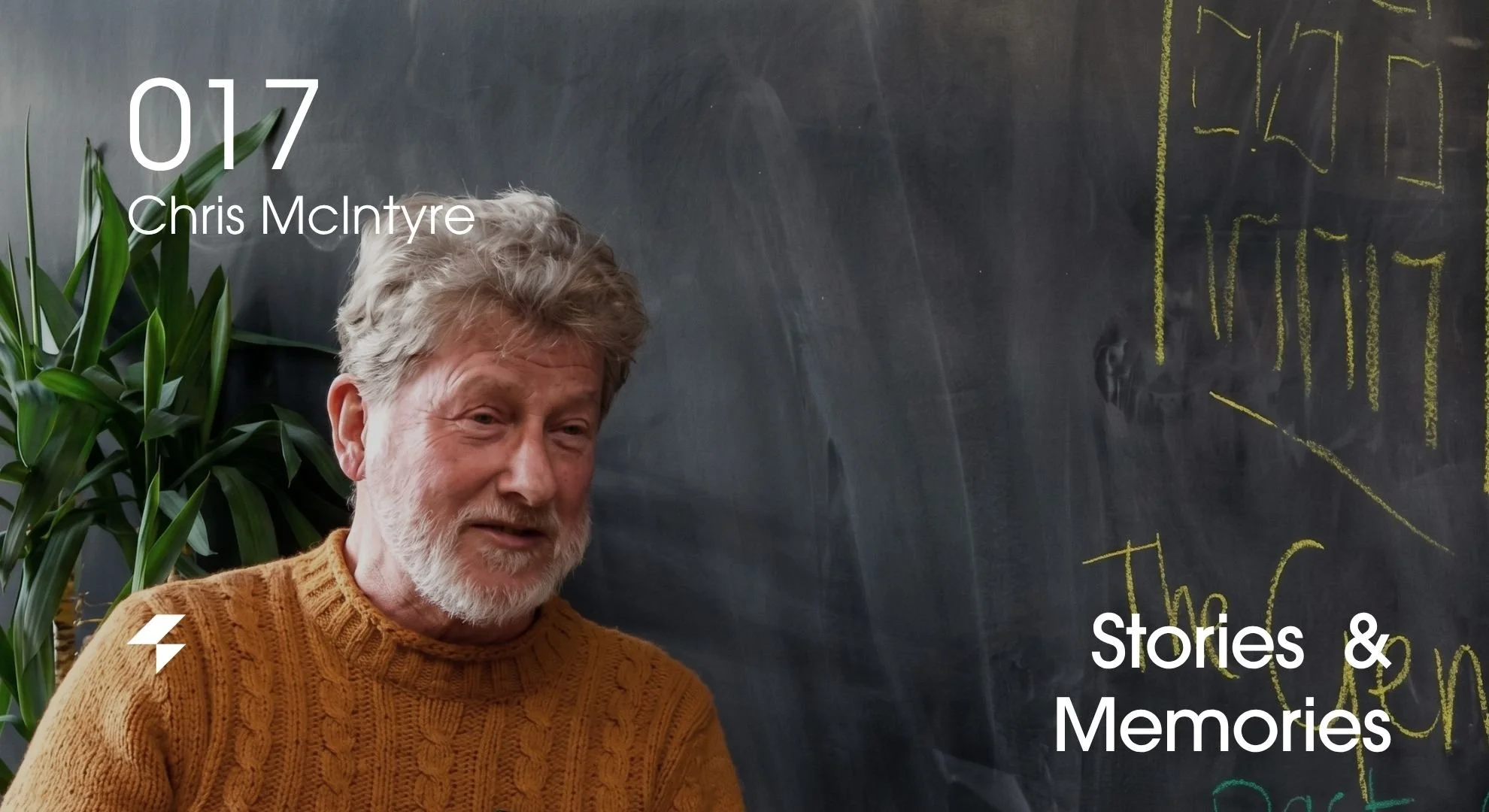
017 Chris McIntyre
Turning the Power Back On by Accident: Chris McIntyre on the Generator's First Life as a Gallery
Chris McIntyre arrived at Loughborough in 1980 as a part-time art history lecturer and rose, over seventeen years, to Vice-Principal, before going on to become inaugural Dean of Art and Design at the University of Hertfordshire. Long before the current renovation, he was part of the small group who first turned the derelict generator hall into an informal exhibition space, complete with a near-miss involving live switchgear and a scattered pool of mercury.
How did you first end up at Loughborough?
Chris: I came in around 1980 as a part-time lecturer, meant to be temporary. I had an interest in formal art history and design history, but they needed people to support the Foundation course, not long after the move to CNAA validation, which meant an extra level of academic rigour was suddenly required. I was offered two days a week doing formal art history, then as I was leaving the room they said students had complained about the Eurocentric curriculum, and asked if I could offer anything from other cultures. I'd done some mask-making for a theatre production and had an interest in Meso and South American culture, so I said yes, and that became three days a week. I decided to move up rather than commute, and ended up staying seventeen years, teaching design history in ceramics, silver, jewellery, all subjects that Loughborough led the field in nationally.
You mentioned a threat to close the college?
Chris: Around 1980 to 1984, the National Advisory Body threatened to close the art college. I was union secretary at the time, and we ran a serious campaign, five hundred students lying down in the marketplace releasing black balloons to symbolise the death of our education, marches, the works. We collected around twenty-five thousand signatures, the president of the Royal Academy's among them, and drove them to Downing Street. We got that threat overturned, and the college became incorporated instead. From there Keith Smith became principal, I became head of 3D, and when Jim Pugh came in from Birmingham, I became Vice-Principal, so in about fourteen years I went from part-time lecturer to Vice-Principal.
Tell us about turning The Generator hall into a gallery for the first time.
Chris: When we brought a new head of 3D up from Birmingham to show him the estate, I took him into The Generator space, which at that point was still full of junk and left-over machinery, apart from the big engines, which were long gone. Students used to get in there unofficially, playing with the huge phosphor bronze switches, opening cabinets with six-foot mercury light bulbs in them. One day, showing him round, I somehow managed to throw the right combination of switches and brought the power back into the building from the grid, sparks, flashing lights, alarms going off, people running out of the Foundation building saying their computers had died. I managed to switch it all off again, but it was a genuinely scary moment.
And the mercury incident?
Chris: Some sculpture students wanted one of the old mercury rectifiers for a sculpture project, and I'd more or less said, go ahead, take it. They broke it trying to move it, and mercury went everywhere across the floor. I found them sweeping it up with a dustpan and brush, which is obviously not how you deal with that. We had to call the college's dangerous materials officer, whose actual name, extraordinarily, was Doctor Hazard, first name Richard, so Doctor Dick Hazard came down in full hazmat gear and cleared everyone out. Frankly, the fact nobody died during that whole informal fit-out is a bit of a surprise to me now.
Watch the Interview
Interview: 017 | Interviewee: Chris McIntyre | Recorded: 05.12.2025 | Duration: 35 minutes | Recorded at: Institute Research Lab, Loughborough | Series: Stories & Memories
How did the gallery actually come together properly?
Chris: Once we'd decided to try it, we did a proper fit, technicians in with pneumatic drills to break up the old concrete engine platforms so we could get a flat floor down, somebody broke a toe on the drill because nobody was wearing proper safety gear in those days. We ran a few shows, starting with a community exhibition where the walls hadn't even been painted yet, then eventually a degree show with proper lighting and heating, so money had clearly gone into it by that point. Eventually the college found funding through the funding council to take on students in that space formally, and it became part of teaching for Foundation, and diploma work in graphics, and that first phase of the gallery came to a natural close.
That experience clearly stayed with you.
Chris: It did. When I became inaugural Dean of Art and Design at Hertfordshire, we were building an entirely new campus, art school, film school, architecture school. There was a wasted outdoor space at one entrance, and I said to the architect, we should put a gallery here instead. He said it could cost half a million pounds, and back when you could still do that kind of thing, I took photographs of the model straight to the board and got it approved. We built it ten metres square and ten metres high, purely because of what I'd seen was possible with sheer scale in The Generator, that same feeling you get in a space like the Turbine Hall. It worked perfectly, ended up one of the best galleries in Hertfordshire.
What would you like to see happen with The Generator now?
Chris: The same thing I've always believed in: a genuinely high-quality, professionally run, supportive space, open to the whole community, but capable of the highest quality artistic experiences too. My experience is you often have to do this iteratively, get it open, make it safe, and build up from there rather than waiting for a perfect formal scheme. I'm working with a theatre group in St Albans doing exactly that right now, converting an old barn step by step. Get the good groups in, professional and community both, and you start generating interest, then money, then more. Having a cafe and bar right next door, like you already do, matters more than people think, that symbiotic relationship keeps people coming back.
Any final thoughts?
Chris: I'm genuinely delighted this is happening. People like Kevin and others who were around the arts scene back then clearly carried that memory of what the space could be. If there's anything I can do to help going forward, connections through the Arts Council, other boards I've sat on, I'm happy to. I've also gone through old photographs and found about a hundred images from that first fit-out and those early shows, gallery space full of junk, the first exhibition, a degree show, which I'll leave with you under a Creative Commons licence, given the Heritage Lottery funding, just credit me for the photographs.
With thanks to Chris McIntyre for sharing his memories as part of The Generator's Stories & Memories oral history project.
