

016 Purnima Chadha
The Remover of Obstacles: Purnima Chadha on Elephants, Engineering and a Life of Saying Yes
Purnima Chadha has lived in Loughborough for fifty years, studying an art degree at The Generator building itself, training as an electronics engineer at what's now De Montfort University, and building a decades-long relationship with Kevin Ryan and Charnwood Arts along the way. In this interview, she talks about life drawing, the symbolism behind the elephants she sculpts, and a habit of taking on exactly the things people told her she couldn't.
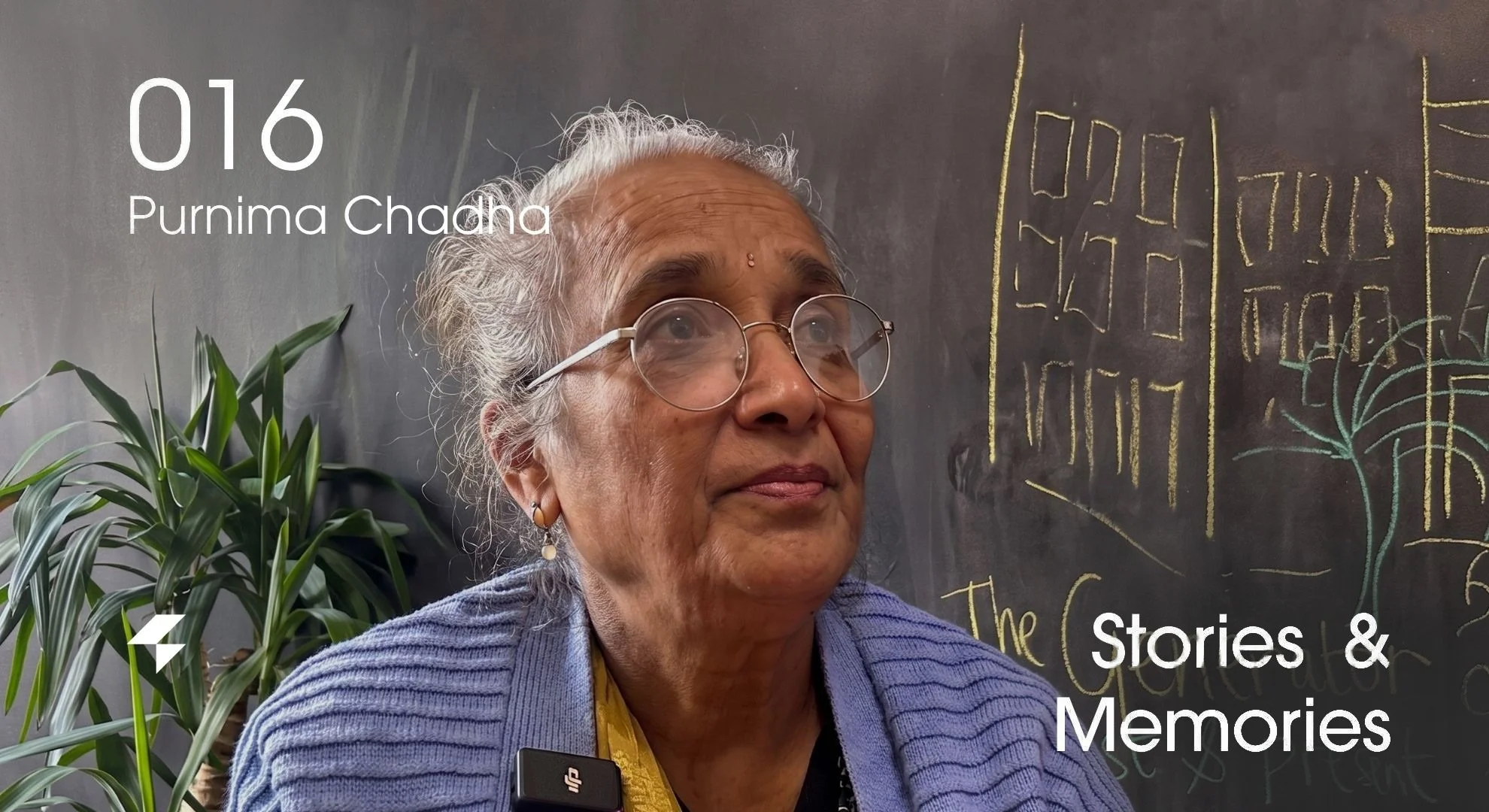
What's your connection to the Generator building?
Purnima: I've been in Loughborough for fifty years, and my connection with The Generator is that I studied there, I did an art degree. I used to go there for life drawing.
What do you remember from your studies?
Purnima: I think I did some good ones, life drawings, which people tended to like. But I was scared to bring things home, because in our culture we're not brought up to do that kind of thing. So it was a shock to be studying the nude body, but I was in the mode of challenging myself. I was surprised myself, that whatever I did, people liked it. At the beginning I was hiding behind the easel.
You mentioned cutting up a lot of that work afterwards?
Purnima: Yes, I've cut up most of the paintings I did, only one has ever been in a gallery. Not to destroy them, I'm a recycler, so I used the material for other things. I don't think I was embarrassed, more just afraid to ask certain questions at the time. And there was a funny thing too, the model sitting for one of the life drawing sessions was someone I actually knew, which was a bit awkward.
How did you first get to know Kevin Ryan?
Purnima: Kevin really helped me from the beginning. I was on the committee at the very early stages, and I kept saying I can't do this, I can't do that, and he pushed me to keep going. His wife Frances helped me too. I was part of the discussions about what might happen with The Generator, and we came to the place quite a few times. Then things happened in the family and I got disconnected for a while, I ended up in Sheffield with my son. I'm still trying to get back into what I was doing before that.
You had an exhibition with Kevin's help too?
Purnima: Yes, for my fiftieth birthday, that was one of my bucket list things, though I didn't even know what a bucket list was until my children and grandchildren started using the phrase. Kevin helped me all the way through, along with James and Jemma. I was part of the committee, signing cheques, making payments, working alongside Kevin even though he was always so busy. I've since done a seventieth birthday exhibition too, with Jemma's help, and we've been in the newspaper a few times over the years.
What was Kevin's vision for The Generator, as you understood it?
Purnima: Including all communities, always. That was his main thing, always thinking about other people, how to get them involved. He worked with people from lots of different cultures and languages, not just mine, and with different faith groups too, multi-faith churches. That was his influence, and I really enjoyed being part of it.
What would you like to see happen when The Generator reopens?
Purnima: All the communities coming together and using the place. Once things start happening there, it'll be good for Loughborough.
Watch the Interview
Interview: 016 | Interviewee: Purnima Chadha | Recorded: 05.12.2025 | Duration: 19 minutes | Recorded at: Institute Research Lab, Loughborough | Series: Stories & Memories
Tell us about your electronics engineering background.
Purnima: I studied that at what's now De Montfort, in 1982, electronic engineering, because at the time there was a real lack of women in the industry, and the government was offering to pay for childcare, fifty pounds, to encourage women to take it up. I took the opportunity. I'd never been to high school, but I was good at maths, verbally, from working as a young girl doing sales in Mombasa. I've always been good at talking.
And that connects to the playgroup you set up?
Purnima: It started because I couldn't afford a pound a week for one child to go to a playgroup, let alone three pounds for three children. So I set up my own, at the Sri Ramakrishna Centre, the first thing ever to happen there. People challenged me, said I had to have fifty percent English children mixed in, and I wasn't going to accept being told I couldn't do it. I raised the funding myself, did the training, and ran that playgroup for ten years. I told myself, I'll do something nobody can take off me, that's just me being strong-minded.
You did quite a bit of workshop work with Charnwood Arts too, didn't you?
Purnima: Yes, I remember the kite flying workshop especially, around 1984, at the Sri Ramakrishna Centre in January, we made kites together. I also worked with Paul Gent on printing, and did a workshop with Bill Brookman, the storytelling and clown performer. It was hard work sometimes, I had to bring my own children along a lot of the time, but with everyone taking part, it was good.
Tell us about the elephants in your artwork.
Purnima: The elephant is a symbol, Lord Ganesha. We turn to Ganesha first in almost anything we do, a birth ceremony, moving into a new house, even ceremonies for money and Lakshmi, the goddess of prosperity, Ganesha still comes first. He was given a boon (special blessing) by his father that he must always come first, and there's a story behind it: he represents the remover of obstacles. That's why we pray to him before anything else, to clear whatever's in the way.
Looking back, how do you feel about everything you've given to Loughborough?
Purnima: I've done so much voluntary work over the years, teaching, workshops, the playgroup, none of it paid, but I'm proud of it, and I'm happy.
With thanks to Purnima Chadha for sharing her memories as part of The Generator's Stories & Memories oral history project.
