

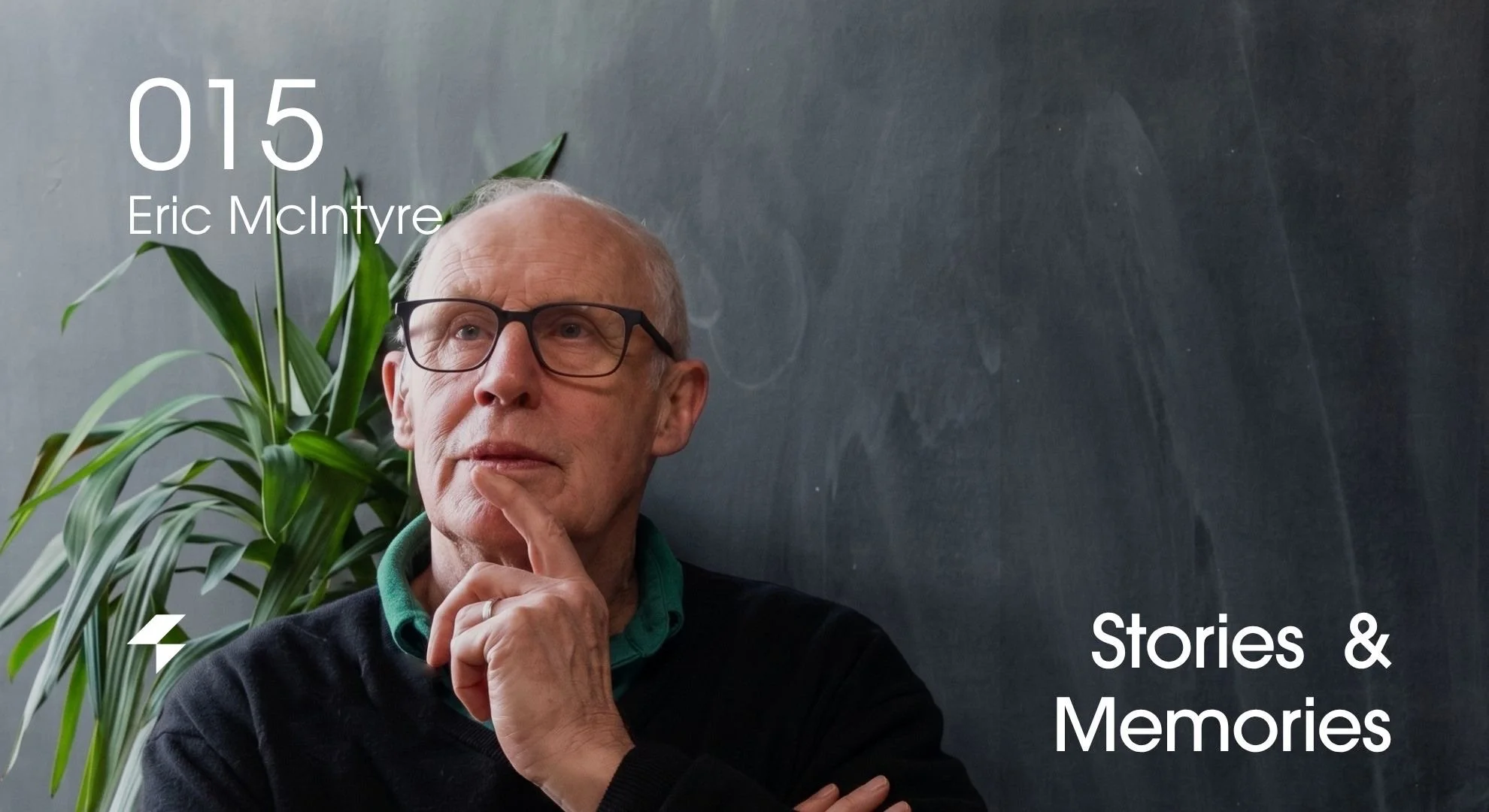
015 Eric McIntyre
He Bought a Hotel in Skegness for His Students: Eric McIntyre on Herbert Schofield's Legacy
Eric McIntyre worked at Loughborough Technical College, now Loughborough College, from 1978 to 2014, and has since written a history of sport across the university and colleges. In this interview, recorded with the Generator's Community Engagement Coordinator Pasha, he traces the building's story back to 1909 and the man he calls the true father of everything educational in Loughborough post-16: Herbert Schofield.
Where does the story actually begin?
Eric: In 1909, the Loughborough Technical Institute was founded in what's now Sainsbury's. There's a plaque commemorating that, and the only other original piece of it left is a Loughborough College coping stone you can still see on the lane opposite. Schofield became principal in 1915, right in the middle of the First World War, and he immediately set to work on engineering and production schemes for making armaments and shells, contributing so much to the war effort that he got the MBE for it. But just as importantly, he used that position to gain phenomenal resources for his college.
That's where the generator connection starts, isn't it?
Eric: Yes. A lot of German submarines were impounded after the First World War, and rather than give the equipment back to Germany, the Ministry of Works offered material from these ships to Schofield and his college. He sent students down, with the famous G.F. Driver, to strip them of useful equipment, most particularly diesel generators. Those went into a building, not this one at that stage, a wooden hut on Frederick Street, and powered the college buildings around Green Close. There's a wonderful story in one of Leonard Cantor's histories about how in 1927 the town suffered a power cut, and the college was the only building able to keep going, because of Schofield's German diesel generators.
So the current brick building came later?
Eric: That's my belief, yes, that the generators were installed in a wooden hut first, and brick was built around it before the wood was dismantled. There may even be original drawings somewhere in the university archives, it's worth a look.
What kind of man was Schofield?
Eric: An utter visionary, an entrepreneur in every sense. A maverick too, if he existed today and had to follow modern procedures, that would be his problem. He'd hear that a big house had come up for sale in Loughborough and phone straight away to say, take it off the market, the college is having it, with no formal approval at all, because he knew he'd get the backing of the education authorities. He worked closely with a man called Brockington, director of education for forty-seven years, and that partnership was fantastic. Nothing was ever wasted with Schofield either. Recycling a German U-boat is pretty impressive, and it's absolutely typical of the man.
How holistic was his approach, really?
Eric: Completely. He looked after mind, body and soul. Before he developed anything on the other side of Epinal Way, he bought land for sports and recreation facilities, the first gym, which is now the Ashby Road roundabout. Halls of residence around Ashby Road and Hall Drive were acquired from what had been private houses. Catering facilities, all of it. And when many of his international students couldn't afford to go home for the summer in the 1930s, he bought a hotel in Skegness to give them holidays. That's the holistic approach in a nutshell.
Watch the Interview
Hear Eric trace The Generator's origins back to stripped German U-boat engines after the First World War, and lay out Herbert Schofield's remarkable, holistic vision for the college, from a Skegness hotel bought for international students to the class shift that reshaped who the institution served.
Interview: 015 | Interviewee: Eric McIntyre | Duration: 34 minutes | Recorded at: Institute Research Lab | Series: Stories & Memories
Was the college always drawing in students from beyond Loughborough?
Eric: From the very early days, yes, certainly from the 1920s. Schofield made many overseas trips himself and recruited students from all over. He was greatly respected abroad. I don't know how many others were doing that kind of thing in the twenties and thirties, but I doubt many were as entrepreneurial as him.
What about the class dimension of all this?
Eric: In 1909, the institute was created for working-class people, full stop. That gradually changed as Schofield began what we'd now call university-level courses in the 1920s, but for a huge period the bread and butter was part-time and evening students, people working at the big local employers, Herbert Morris's, Brush, and so on. The 1944 Education Act, the Butler Act, was a key turning point, raising the school leaving age and giving people like Schofield real opportunities to train teachers, and the number of teachers being trained rocketed after that.
Did that class shift affect the relationship between the town and the institution?
Eric: I think Schofield did everything he could to promote what's called town and gown. He held a big rag parade every year, and a more formal ceremony called College Sunday, with archbishops and a huge procession through the town. As the university expanded and eventually gained university status in 1966, and everything shifted away from the original town-centre buildings towards what's now the main campus, that closeness inevitably loosened a bit. I don't think it's as strong now as it once was, or as strong as it should be, though that's no criticism of anyone currently doing the work, it's just the nature of how things grew.
What would you like to see happen with the building now?
Eric: I'd push hard on relationships with the university, the college, and local schools, you can never do enough of that. I'd make young people a big focus, and I'd actually involve them in the management structures, not to tell you how to run your board, but genuinely consult them, because good or bad, they've all got opinions worth hearing. Beyond the institutional level, you'd be astonished how many local organisations would welcome a focal point like this, especially with the social eating facility right beside it. I can't think of another opportunity quite as good.
Any personal connection to art yourself?
Eric: I'd have to be honest, I'm more a words person. I was never really taught art at school, we were told it was for people who were supposed to be clever, and I'm not intelligent in that way, or so we were told. But I have an appreciation for painting, even though I can't paint myself, and I've a good eye for photography and photo sourcing from all the archive work I've done. I've met your new archivist, Ruth, this week, and I think that's going to be a very productive relationship, I know the sources, and she's finding her feet fast.
With thanks to Eric McIntyre for sharing his memories as part of The Generator's Stories & Memories oral history project.
