

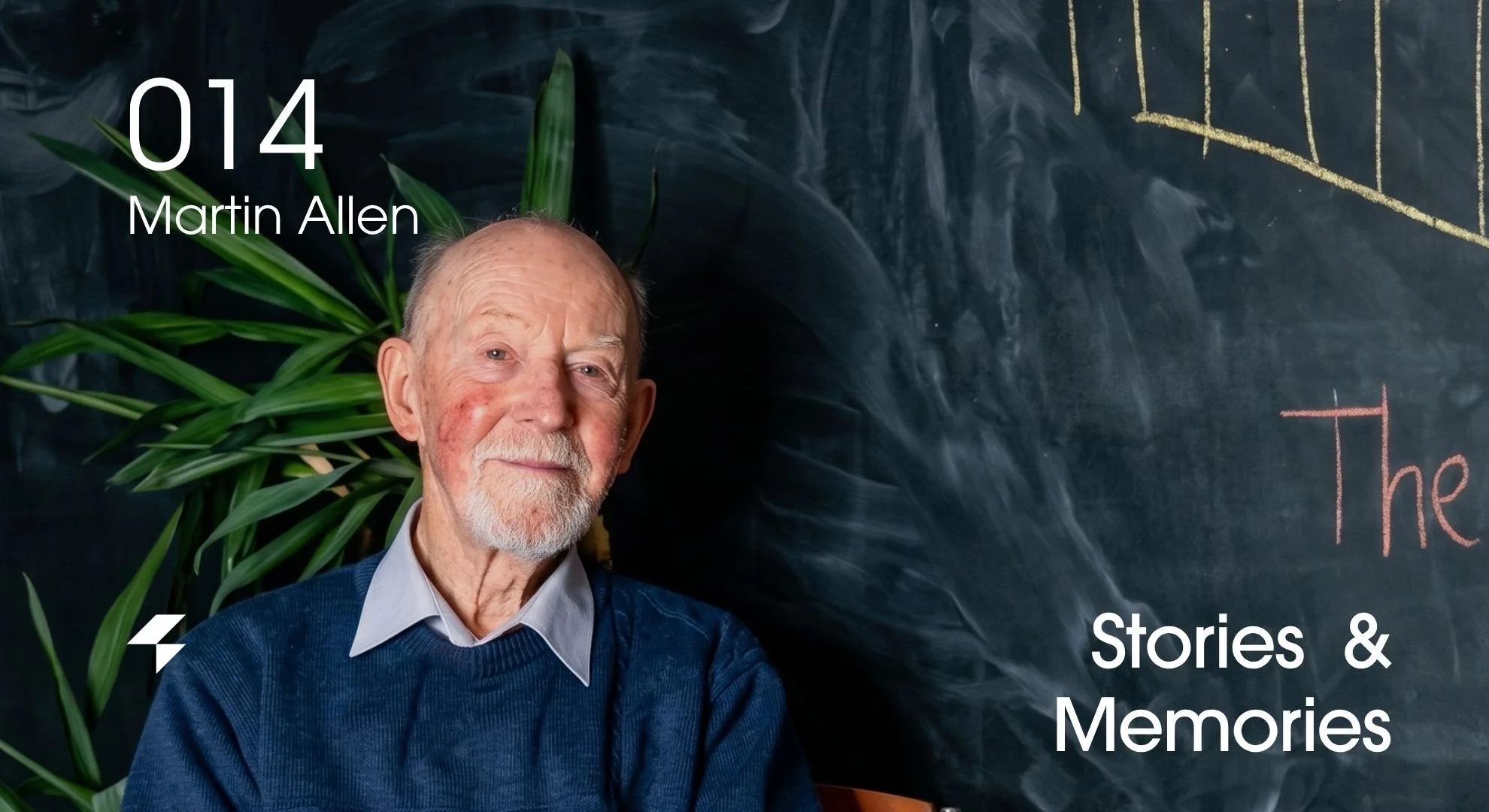
014 Martin Allen
Painting a Sunbeam Under the Generator's Roof: Martin Allen on Sixty Years with Loughborough College
Martin Allen's connection to Loughborough began almost by accident, brought to the town as a child during the Second World War, and went on to span a Loughborough College diploma in the late 1940s, a career in the earliest days of semiconductor and microprocessor technology, and a return to teach at Frederick Street from 1966 until his retirement in 1992. In this interview, recorded at The Generator during a Heritage Weekend, he recalls the building as a student, a lecturer, and even, briefly, a place to repaint his car.
How did you end up in Loughborough in the first place?
Martin: I'm not a Loughborough chap at all. It was getting a little bit exciting up in the North East where we lived, and my father was able to move his job, so we came down and lived with my aunt in Shepshed for a while. I'd already passed the scholarship for the local school, but got transferred to Loughborough Grammar School instead, and spent the years 1942 to 1947 there. Then I was told about a scholarship for a Shepshed boy to study electrical engineering at the college, and I was very lucky indeed to get it.
What was studying here like?
Martin: I did the diploma of Loughborough College from 1947 to 1952, alongside an external London University degree, since the college itself only ran diplomas at the time, though of degree equivalent standard. The university has since said you can swap the diploma for a degree, but I wouldn't do that. I'm still proud of my diploma.
And after you graduated?
Martin: I registered as a conscientious objector for National Service, because I couldn't square war with my Christian conviction. I had to appear before a tribunal, and they decided on alternative service, so I spent two years and sixty days as a hospital porter, which was very interesting. After that I worked for GEC in Coventry, making some of the very earliest transistors, point-contact diodes, and I came up with a simpler way of producing them. We were making about ten thousand a week. Later I moved to Hazel Grove, working on the techniques that are now standard for making integrated circuit chips, diffusion and photoresistors. I was very privileged to be working right at the beginning of all that.
What brought you into teaching?
Martin: My mother kept telling me I ought to go into teaching, and I didn't want to, I was an engineer. But I applied for a lecturer post at Stockport College almost on a whim, just to have a look at the place. The electrical department was in an old brewery, and it smelled delicious. I was offered the job on the spot and told, we don't expect you to confirm at interview if you don't want it, so for once in my life I made a snap decision and took it. That was the beginning of my teaching career.
When did you come back to Loughborough?
Martin: I came back on staff in 1966, working in what we called the garage block, so I've been involved with Frederick Street for a long time. The power station itself had been connected to the National Grid by 1960, but it was still being used to make DC using mercury arc rectifiers, this big thing that looked like an octopus, a glass bowl with things sticking up inside. The engines themselves were no longer running, but they were still standing there when I arrived. We believe now that the German submarine diesel engines were actually removed around 1948 or 1949 and replaced with British ones, and those in turn were eventually taken out too. What happened to them, nobody really knows. Scrap, most likely.
What was the building itself like in those days?
Martin: Very noisy when it was running, but kept to a very high standard, clean and well maintained. That was true of the whole college really, Schofield wanted it that way, all the woodwork, the brickwork, the windows, all had to be right. That wonderful chessboard-patterned floor, I'm glad to hear some of it's been preserved.
Did you have much to do with Schofield himself?
Martin: He was around all the time, you'd see him in the corridors, wouldn't necessarily speak to him, but you were very conscious he was the head of the college, he was in charge. My father actually played a trick on him once. We'd gone to a meeting in the old college building on the corner, now Sainsbury's, running a little late, and at the bottom of the staircase there was a bowler hat hanging on the post that Schofield had left there while he went up. My father, being a bit of a devil, popped it on his own head, even though it was far too big and came right down over his ears. He took it off again before going in, but I've always remembered that.
You mentioned painting a car in the generator building?
Martin: Yes, my Sunbeam, it needed painting in 1965, and when we moved here in '66 I had access to the building, so I brought it in through the big doors into the generating station and painted it green. I think I still had the green paint on the floor at one point. I had my Land Rover in there too, before we handed the building over, moving up to the Radmoor site, and you couldn't park outside without getting a ticket, so we just bumped it in.
Watch the Interview
Interview: 014 | Interviewee: Martin Allen | Recorded: 08.10.2025 | Duration: 49 minutes | Recorded at: Institute Research Lab, Loughborough | Series: Stories & Memories
Was there any connection between the garage block and the generator building itself?
Martin: Yes, there was a staircase down from our first floor level into the battery room, which is where the generator's battery room was, and that later became the darkroom area when it was the art college. We used the battery room for electrical installation training, students from local employers like Brush, Morris's and Cottons, three big, well-respected engineering firms, coming in on day release to learn practical wiring skills.
When did you retire?
Martin: In 1992. I'd had a really enjoyable and happy career. Shortly afterwards my wife was paralysed, and for the next twenty-four years my job was as her full-time carer. We had a good life regardless. We modified a camper van and went off camping, which kept me busy, and my hobby is old cars, so when I could sneak away I'd work on that, a Sunbeam that will be a hundred years old this month.
You also had a hand in restoring the college's original name, didn't you?
Martin: I did feel great loyalty to the place. I said to the then principal, Don Hutchings, that I wished we'd go back to the original name, since it used to say Loughborough College on the central station platform when you arrived. I asked if he thought the governors would agree to calling it Loughborough College again, and he said he'd give it a try, and they agreed. I was glad about that, it keeps the heritage in the name.
What would you like to see happening in the building now?
Martin: I'm fond of the theatre, and I've always regretted that we lost the little theatre that used to be at Stanford Hall, a beautiful space. I think this building would be a suitable venue for that sort of thing, recitals, amateur dramatic societies rehearsing and putting on concerts and promotional events, even if it's not quite big enough for their largest productions.
Any final thoughts on Schofield's vision for the college?
Martin: I think it was a brilliant idea, learning through production. Some people condemned it as profiteering off students, but we learned skills, we knew what we were doing. I remember a manager where I did my graduate apprenticeship telling me, we like you Loughborough people, you know what it's about. That was the essence of Schofield's philosophy, I think: you weren't shown everything, but you learned to appreciate how things were made, designed, machined, put together, the whole process. He wanted to produce engineers who could go anywhere and do anything, and we had a lot of overseas students on the courses too, which I valued, because it meant I never had any qualms about mixing with people from other parts of the world. They were here, they were in my group. I think that was a tremendous thing, and it's gratifying, all these years on, to feel that a career like that was worth it.
With thanks to Martin Allen for sharing his memories as part of The Generator's Stories & Memories oral history project.
