

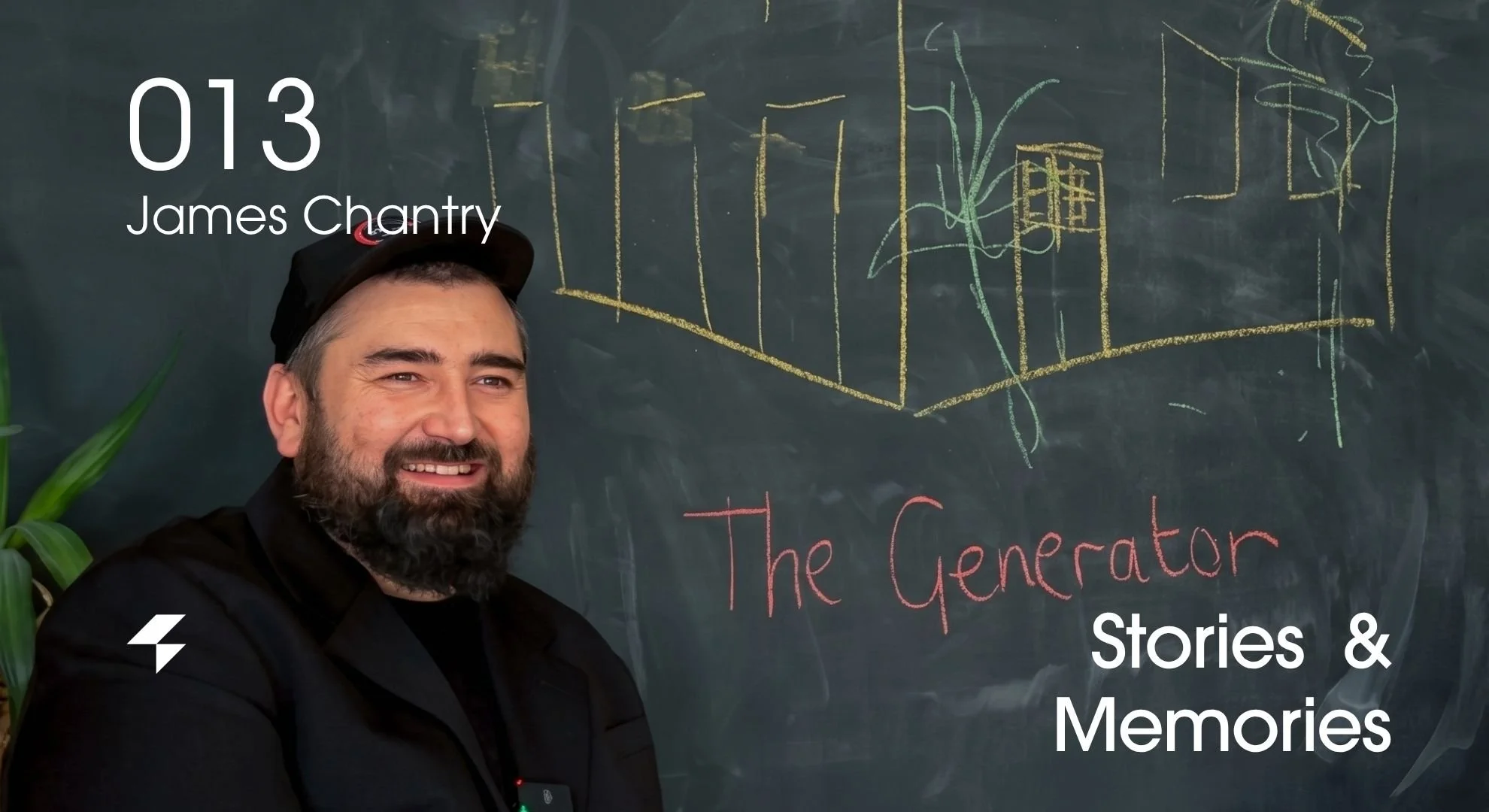
013 James Chantry
Dreaming for Real: James Chantry on Kevin Ryan's Vision for The Generator
James Chantry is an artist, academic and writer who worked closely with Kevin Ryan, widely regarded as the driving vision behind The Generator, during the project's founding years at Charnwood Arts. In this interview, he traces Kevin's vision back over a decade of conversations before the building was ever handed over, and reflects on what it meant to be alongside him as that vision became real.
What's your connection to The Generator?
James: I formerly worked at Charnwood Arts in the town and worked closely with Kevin Ryan, who was really the thought architect behind The Generator. I worked alongside him in its inception, probably about ten years ago, and was part of initiatives that happened when it was acquired as a CIC, like the Firing the Generator project.
Tell us about Firing the Generator.
James: There were huge cardboard boxes and acrobats in the space. It was a community creative consultation, phenomenal, over a whole weekend. Progressive, experimental architects came and used cardboard boxes to transform the space, in stages, in different areas. Paul Gent was drawing the community live, and the conversations happening in there, so there was this visual documentation happening alongside it. It was the most brilliant, speculative way of working: what could this space be, how could it happen. Kevin used to call it "dreaming for real." The building was semi-derelict at the time, safe enough to be in, but we had to bring in portable toilets, sinks with buckets underneath. And yet there were live performers, talks, an acrobat anchored to the whole scene. It drew in so many people who already had a connection to that building.
Who was Kevin Ryan?
James: Kevin was CEO of Charnwood Arts for decades. He came in in the early nineties, I believe originally brought in by the Arts Council to close it down, and instead transformed it into a real force in the town, working with artists, performers, writers and creatives from across Leicestershire. He always had a passion for a venue in Loughborough that could house and respond to the town's creative community, which is genuinely dynamic because of the university, the college, and the foundation course tradition here. He was interested in cohesion, bringing that whole myriad of arts and culture together in a Midlands town that often gets overlooked.
What was his vision for the space itself?
James: He talked about a layered approach: the heritage of the building and why it came about, so integral to Loughborough's industrial past; the space itself and how different communities could use it; performance; and visual arts, with a real focus on underrepresented people having ownership of the space and a say in how it was used. It's always been at the heart of the community, multipurpose, and I think his vision was for it to become this embryonic place for things to explode out of.
You have a personal connection to the building too, don't you?
James: A slightly strange one. I'm from North Lincolnshire, but my dad did his foundation there in 1971 and used to talk about that space. So I grew up with this almost inherited sense of it, images and stories about tutors bringing in rabbits and game birds for the students to draw for days on end, the smell of it, this Bauhaus-type freedom to use such a vast space. That was my first connection, tenuous as it was, long before I had any real link to Leicestershire.
Watch the Interview
Hear James talk about the Firing the Generator consultation weekend, working alongside Kevin Ryan through more than a decade of planning, and what it meant to be handed the keys to an empty building and told it was finally happening.
Interview: 013 | Interviewee: James Chantry | Interview date: 08.10.2025 | Duration: 31 minutes | Recorded at: Institute Research Lab, Loughborough | Series: Stories & Memories
What was it like being around Kevin as the vision developed?
James: He was enthralling in how he spoke about things and planned them, always believing it would happen. Meetings with him would usually involve walking about three miles around the town, following him from place to place as he met hundreds of different people. When the building was finally handed over from the university to the CIC, he was just given this old Yale key and told, right, it's yours, it's vacant. I remember the two of us running round the space, up and down through all the levels, in absolute awe. It felt like it held so much intrinsic power, atmosphere and energy from everything and everyone that had passed through it.
How long had he actually been working towards this?
James: Decades, really. I think conversations about that building went back to at least the early eighties. By the time Kevin became very ill, one of our board members, Jill Vincent, who worked closely with him, tracked back an email trail going back thirteen years, and it turned out to be closer to fourteen. He'd been talking about it for that long.
Can you tell us about that period, towards the end?
James: He knew for some months that he was likely to pass away, and The Generator was mentioned in the conversations we had during that time. It was a real key thing for him that the legacy carried on, and he knew it was in safe hands. By that point it had actually reached the stage where it was really going to happen, and I know that made him very proud, and very happy, knowing his legacy would be able to continue.
What do you think the building offers that arts activity alone doesn't?
James: In its essence, the arts do not need a building to be transformative. We have such rich community groups across cultures, religions, class, gender, sexuality in this town, and they don't need a space to exist. But it's a fascinating thing to give people a platform, ownership of something. A building offers a point of gathering, interconnectedness, bridge building. I also think it has a place to demystify the arts, to show people who might not usually connect with art that there's an intersection with something completely new happening in their town.
As someone who now teaches at the university, how do you see students engaging with it?
James: I think it's a really interesting idea for the foundation course to return to the space, to be part of projects, a space of experimentation again, bringing in students from local, national and international communities and making them part of this community within Loughborough. Given the emphasis in how we run Foundation now, on experimentation, play, being bold, I think a building with that history and that scale is a genuinely exciting fit.
Looking back, what does Kevin's vision mean to you now?
James: It's essential to the building's tapestry. He talked about the psychogeography of a space that carries so much human connection through heritage, history, the personal and the collective, and everything transformative that's already happened there. That legacy is what makes what's happening now so exciting. We were a team, myself alongside Kevin, along with Natalie Chabaud, Jemma Bagley and Terry Allen and many others, but being alongside him in those early stages, running round with that old key, knowing this is really happening, that's something I'll always carry.
With thanks to James Chantry for sharing his memories as part of The Generator's Stories & Memories oral history project.
