

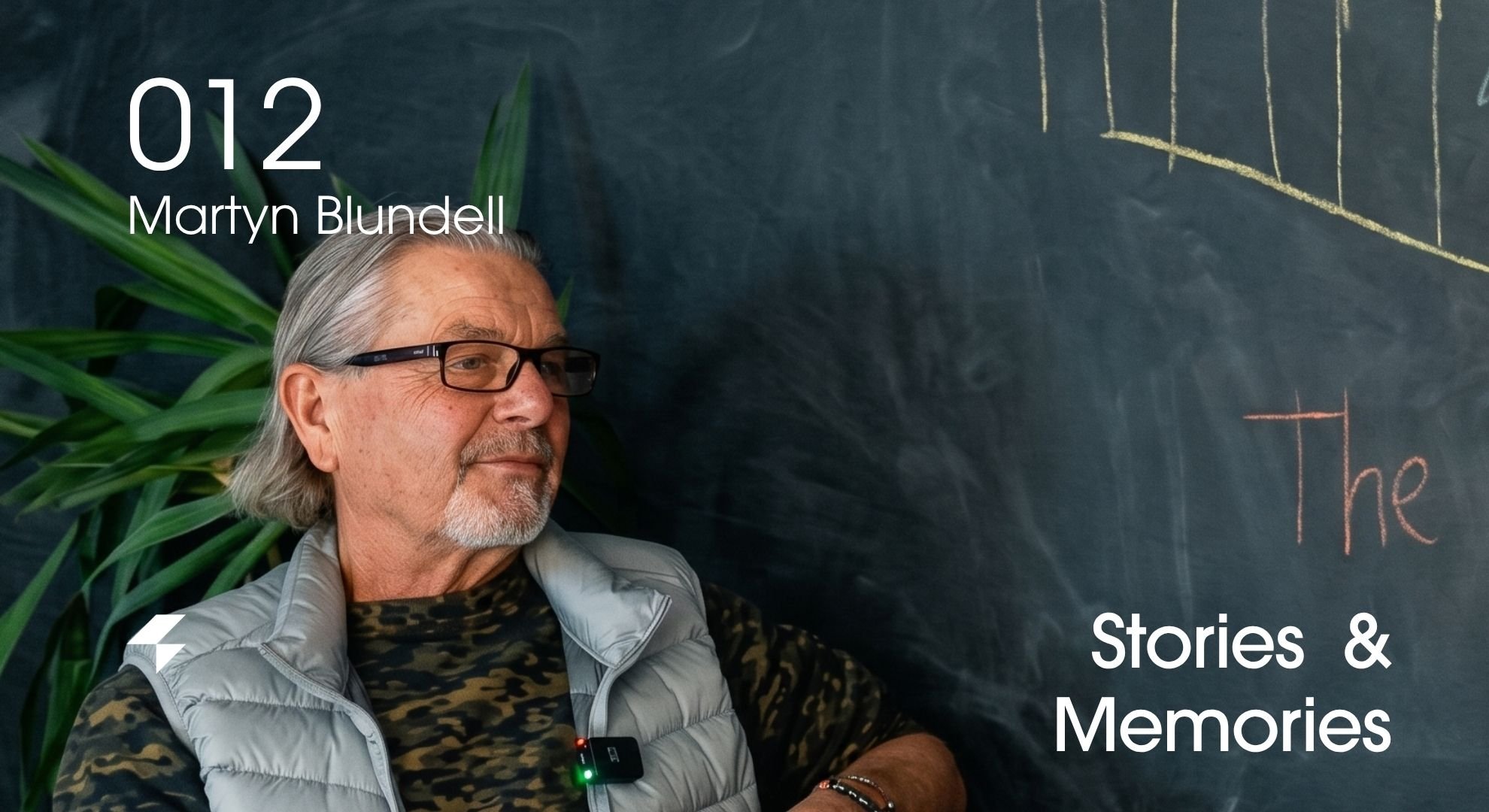
012 Martyn Blundell
Why Drawing Is the Core of Everything: Martyn Blundell on Three Decades of Teaching Foundation Art
Martyn came to the building sideways, picking up part-time teaching through people he met in the pub rather than through any formal route. He taught drawing across textiles, ceramics, furniture and jewellery, then foundation, BTEC and fashion, all while working other jobs at Central Saint Martins, Norwich, Nottingham Trent and beyond. That outsider's vantage gave him a rare basis for comparison, and in this interview he explains why drawing sits at the centre of everything he's taught, and why Frederick Street still comes out ahead of every other institution he's worked in.
How did you end up teaching at Loughborough?
Martyn: I studied at Loughborough myself, printmaking, and picked up some part-time teaching in Liverpool where I was brought up. It was through a guy I met teaching there who had a friend called Dave Johnson, who was running printed textiles at Loughborough. We met in the pub one night, he offered me some teaching on textiles, and that's where I really started, just doing a couple of workshops with his second year print students.
What was the building actually like to work in?
Martyn: I did my own Foundation at Southport, in a beautiful old building, and when you walked through the door it felt like, this is an art school. Frederick Street had that same kind of vibe. Everybody who studied there, staff and students, loved the place. It felt special, and it was hard to get in. You just felt like you were in a very special place. A lot of the spaces were compromised in terms of how they were used, and there were health and safety issues, but regardless of all that, it had a good buzz. A real community.
Any thoughts on why that was?
Martyn: There's been a lot of research about educational spaces and light, and open spaces creating a more positive mindset than small contained ones. I think that's part of it. It's the same at Norwich, another beautiful old building. If students want to come into the building, everyone turns up, and that forms the community. You had the pub, the Griffin next door, that was part of it too.
What do you remember about working in the gallery space itself, what's now The Generator?
Martyn: I worked quite a lot in there. At the start of the Foundation course we'd get all the students in and make huge set-ups, easels, junk, cardboard boxes, clothes, massive piles of anything you could think of, and go around speaking to people one to one. That was really good for big, high work. I also taught life drawing in there, and that was a bit of a nightmare acoustically. You'd walk in and the space felt great, but you just couldn't communicate properly with everybody. I used to do dressing-up sessions with textiles students to music, but you couldn't play music because it was so echoey, and you couldn't speak over it if you did. The infrared heaters round the edges meant your head got hot and your feet stayed cold, which was hard on the models too. Later I shared the space with graphics, a barrier down the middle, textiles on one side and graphics on the other. It didn't really work.
Was it better for other kinds of work?
Martyn: Fine art on the Foundation course worked really well in there, set up with booths so every student had a nice space, plus lots of communal areas for one-to-one teaching. And it had this sort of "we're in this special club" feeling. It was great for installation work too, because of the corridor at the back. Students built cobweb structures across the attic to negotiate through, mazes out of cardboard tubes and boxes you had to physically climb through. One student built a glass door where the original door had been, painted it black, and locked himself inside for his final project, scratching the paint off a bit at a time until the whole thing was clear. Another brought a caravan into the space and built the exhibition around it, so all you saw from outside was a doorway, and stepping through it felt completely disorientating. We had cars in there too, at one point, I can't remember why.
Any memories of the roof?
Martyn: We went up for the solar eclipse, around 2002. It was lunchtime, and the sky just went dark, all the colour went soft, it got quieter, and the birds stopped singing. Very peculiar. Apparently years before that it was all open and students used to work up there, before health and safety put a stop to it.
Pasha: We interviewed a student whose wedding day it was, and they'd all gone up to sunbathe and play guitar, very 1970s, flared towels and sunglasses.
Watch the Interview
Interview: 012 | Interviewee: Martyn Blundell | Interview date: 08.10.2025 | Duration: 36 minutes | Recorded at: Institute Research Lab, Loughborough | Series: Stories & Memories
Tell us about the chickens.
Martyn: That one's second-hand for me. I was told that years ago a member of staff had half a dozen chickens they'd bring into the studio, and instead of drawing the life model you'd spend an hour drawing chickens instead.
How central is drawing to what you teach?
Martyn: I believe drawing is the core of everything. You have to learn how to see. It's how you make an informed aesthetic value judgement about anything you make, and it helps you evaluate and progress what you're doing. It's a way of communicating with others, and with yourself. Ceramics is drawing, jewellery is drawing, painting is drawing, even photography is drawing. I couldn't draw myself when I left art school. A friend at uni taught me, gave me a few tips, and it all started to come together. Later I worked alongside John Downer on foundation, a brilliant drawing teacher, and learned a lot from him about how to structure tuition, two tutors, a model at each end of the room, highly methodical, lots of repetition until students are drawing without worrying about the outcome anymore.
How do you feel about life drawing being dropped from a lot of courses now?
Martyn: It's ridiculous, honestly. I think it stems from something ancient, we just like looking at each other. It's like going to the beach: everyone takes their clothes off as much as feels appropriate and sees each other. The human figure as a subject is inexhaustible. You move a light and the whole problem changes. I suppose it has roots in anatomical study too, Leonardo da Vinci and that kind of scientific route into what became an art in itself.
What's your favourite memory of the building overall?
Martyn: I think it's just that general vibe. I've worked in a lot of different institutions and they all feel different, but there was something special about the Foundation scene there, fresh out of school, full of self-belief, brought together with a good team of staff. Because I was always part time, I was never really tied to one institution, so I could compare across all sorts of different places, and Frederick Street held its own.
With thanks to Martyn Blundell for sharing his memories as part of The Generator's Stories & Memories oral history project.
