

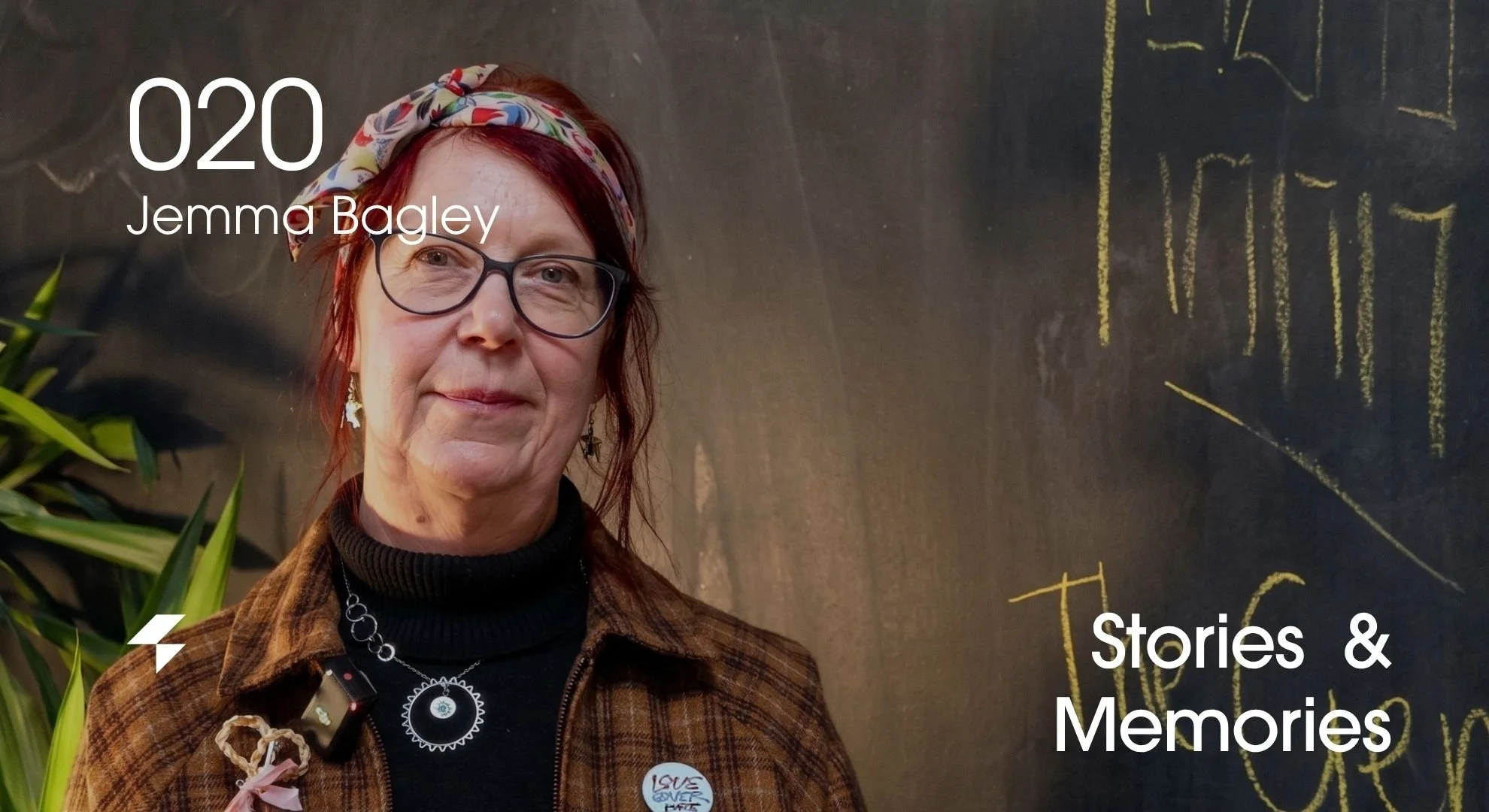
020 Jemma Bagley
A Bucket Catching the Drips: Jemma Bagley on Art Space's Earliest Exhibitions in the Generator Gallery
Jemma Bagley studied textile design at Loughborough Art College from 1987, and by around 1997 was helping run exhibitions and workshops for Art Space, a group still going today, in what was then a semi-derelict generator gallery. In this interview, she talks about hanging work from the building's own gantry hook, an accidental audience wandering in off the street, and how the space taught her almost everything she knows about running a socially engaged arts practice.
What was your earliest connection to the building?
Jemma: Around 1997, I got involved arranging exhibitions and workshops with ArtSpace, and our earliest exhibitions were in The Generator. We hung things from the gantry in there, the big hook and crane, and really explored the scale and industrial character of the space. Some people made site-specific work, others made more conventional pieces, my own work is all 2D, but we used the fabric of the building itself as a starting point. It was the first time I'd had to write a proper funding application, plan a workshop programme, think about getting people into the space. We worked with a curator called Jane Bevan, and I learned a huge amount just being in there.
You mentioned the roof leaking?
Jemma: Even back in the late nineties and early two thousands, there was always a drippy roof. I remember one artist had work up on a wall, and we'd put a bucket underneath to catch the drips, and the drip, drip, drip almost became part of the installation, a kind of accidental sound art.
Who else shaped how you worked in those early days?
Jemma: A woman called Sally Chisholm, who's no longer with us, taught me an enormous amount. She'd been at Edinburgh Art School in the sixties and had all these stories, live pigs turning up in degree shows, that sort of thing. She was a wonderful painter, I still have a portrait she did of me, and she wrote all our funding bids at the time, so I shadowed her and learned the nuts and bolts of putting a bid together. We had a service level agreement with the Borough Council too, running summer workshops people booked by phoning a number. There was no Eventbrite back then.
Tell us about working with school groups.
Jemma: Outwards Edge School used to come in every year, and we'd run workshops responding to whatever was on show. One year, with a friend called Clare Bell, a recycling and environmentally aware artist, we invited people to bring something they'd found on the street, carpet tubes, whatever, and just built an installation from it on the spot. Anyone who wandered through had to join in too, even workmen who'd come to repair something got roped in, we fished a receipt out of one man's pocket and added it to the piece.
What was it like having the big doors open onto the street?
Jemma: Incredibly accessible. People would just wander in off the street before they even realised they were walking into an art exhibition, sometimes with their shopping bags still in hand. We'd end up as temporary custodians of the building, telling people its history, or hearing their own stories about it, someone who used to work there, or wondering what the building was for now. It's always been that kind of space.
You worked on an exhibition for Holocaust Memorial Day too?
Jemma: Yes, with the Borough Council, using large-scale paintings by an artist called Harry Walton, working from photographs of concentration camps, incredibly powerful given the scale you can work at in there. We lined up empty shoes for a roll call, and played Yiddish music, fiddle, someone singing, really evocative. It's a good example of what that space can do with visual art, sound, and something more conceptual all together.
Watch the Interview
Interview: 020 | Interviewee: Jemma Bagley | Recorded: 06.12.2025 | Duration: 22 minutes | Recorded at: Institute Research Lab, Loughborough | Series: Stories & Memories
Were you involved in the Firing the Generator project too?
Jemma: Yes, I was working for Charnwood Arts at that point, so we were closely involved in the early talks. I ran a workshop where people brought something special to them, then chose an area of the building, a mark on a wall, wherever drew them, and we made drawings and short pieces of writing connecting the object and the place. It was about what people bring to a building, and what they take from being in it.
What would you like to see happen with the space now?
Jemma: I'd like it to keep that same accessibility, people wandering in, having an experience, low-cost or free access to something extraordinary. I understand it needs to earn its keep too, but I'd love that walk-in, look-at-this-amazing-space element to survive. Beyond visual art, I think projection and film could work really well, and sound and theatre too, that height lends itself to almost anything. The building's always been part of the experience itself, whatever you put in there, it's exhibiting too.
And your practice today?
Jemma: I work a lot in mental health now, still working with people, still learning from them. It's about process over product, co-creating with people in a mindful way, sometimes it becomes a finished piece, sometimes it doesn't. Working with someone who hasn't drawn since they were a child, because they were told they couldn't, and then seeing them realise they've got work in an exhibition, that means everything. You're seeing potential in something they can't yet see themselves, until you've framed it, or clipped it to a wall, and they go, I've made work for an exhibition. I'm really glad The Generator was part of what enabled me to do that work today.
With thanks to Jemma Bagley for sharing her memories as part of The Generator's Stories & Memories oral history project.
